
As single-cell technologies continue to advance, transcriptomic sequencing has become one of the most widely used tools for defining cellular states. By analyzing gene expression profiles, researchers can classify cell types, identify cellular subpopulations, and investigate cellular heterogeneity.
However, a Perspective article published in Cell raises an important question:
Can molecular information alone provide a complete understanding of living cells?
Moving Beyond Molecular Definitions of Cell State
In traditional biology, cells were often distinguished by their morphology, spatial location, and functional behavior. In the post-genomic era, however, research has increasingly focused on molecular information, with transcriptomics often regarded as the “gold standard” for defining cellular states.
With the rapid development of live-cell imaging, large-scale image datasets, and quantitative image-analysis technologies, researchers are beginning to return their attention to the cell itself.
The authors introduce the concept of the holistic cell state, arguing that cellular state should not be defined solely by gene transcription. A comprehensive assessment must also consider the cell’s physical structure, morphological characteristics, spatial organization, and dynamic behavior.
Why Molecular Information Alone Is Not Enough
A living cell is not a static chemical reaction system in a test tube. It is a highly dynamic, dissipative system that continuously exchanges matter and energy with its environment.
Because living cells remain far from chemical equilibrium, they can respond to external stimuli in highly nonlinear ways.
This presents a fundamental challenge: even if we had access to a complete list of every gene in a cell, it would still be difficult to predict exactly how that cell would behave.
Bottom-up models based solely on molecular information therefore have clear limitations when applied to complex eukaryotic cells. Genes may indicate what a cell is capable of doing, but its actual phenotype and future behavior are also shaped by spatial organization, the surrounding microenvironment, and changes over time.
This helps explain a common observation in biological research: cells with similar transcriptomic profiles may display very different morphologies, functions, and developmental trajectories.
When researchers rely only on sequencing data, these important phenotypic and behavioral differences may be overlooked.
Integrating Molecular and Imaging Data
The Perspective suggests that the future of cell research lies in multidimensional data integration.
Molecular omics data should be combined with information obtained through single-cell imaging, including:
- Cellular morphology
- Spatial organization
- Temporal changes
- Dynamic cellular behavior
- Cell-state transitions
By integrating these complementary dimensions, researchers can develop a more comprehensive understanding of cellular states and how cells transition from one state to another.
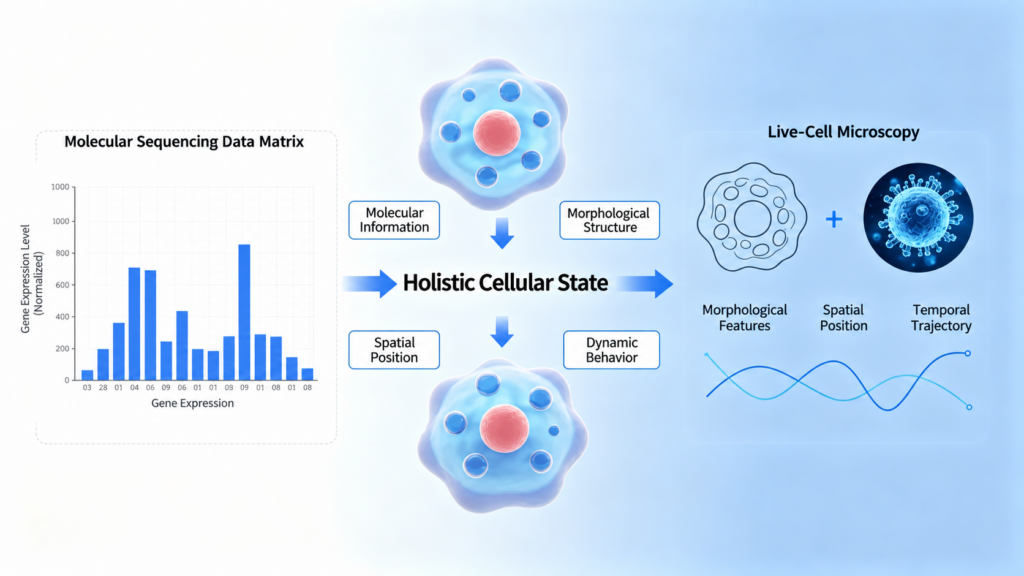
Conceptual illustration of the holistic cell state, integrating molecular information with cellular morphology, spatial organization, and dynamic behavior.
Cell State Is a Dynamic Process
A cellular state should not be viewed as a fixed label. Cells continuously respond to environmental signals and may gradually shift or transition between different functional states.
These dynamic changes are particularly important in fields such as:
- Drug discovery and screening
- Organoid research
- Stem-cell differentiation
- Developmental biology
- Cancer research
- Cell-response studies
Sequencing technologies are highly effective at capturing molecular information at a particular time point. In many cases, however, they provide only a snapshot of the cell.
Live-cell imaging offers a complementary perspective by continuously recording changes in cellular morphology and behavior over time. This longitudinal information can help researchers observe when a transition begins, how it progresses, and how individual cells respond differently under the same experimental conditions.
Complementary Technologies for a More Complete Picture
This perspective does not diminish the scientific value of sequencing. Instead, it reminds researchers of the limitations of relying on a single dimension of information.
Omics technologies provide essential molecular-level information, while live-cell imaging reveals physical, morphological, spatial, and behavioral phenotypes.
By combining these approaches, researchers can build a more complete representation of the living cell—one that is closer to its true biological state.
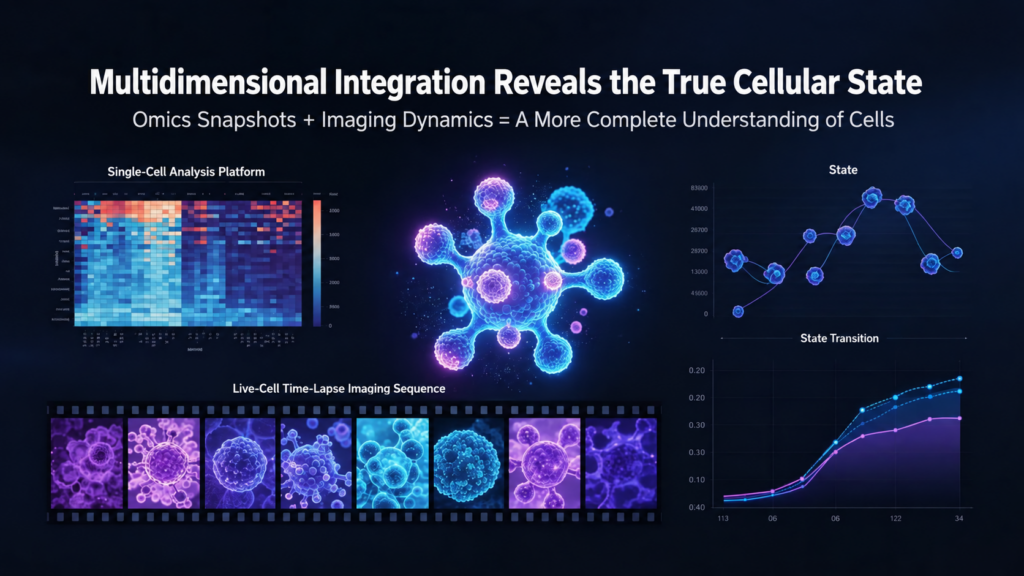
A future research framework for analyzing cell-state transitions through the integration of multidimensional molecular data and time-lapse imaging.
Key Takeaways
- Transcriptomic information alone may not fully characterize the state of a living cell.
- The concept of the holistic cell state combines molecular information with morphological, spatial, and dynamic imaging data.
- Cell states are not fixed labels but dynamic processes that change in response to internal and external factors.
- The integration of multi-omics data with longitudinal live-cell imaging is likely to become an important direction in future cell research.
Live-Cell Imaging as an Analytical Tool
This Perspective also provides a strong conceptual foundation for the growing importance of live-cell imaging technologies.
In single-cell research, imaging is no longer used simply to obtain visual records. It is becoming an essential analytical approach for observing phenotypic changes, tracking cell-state transitions, and studying cellular behavior over time.
MSHOT develops microscopy and live-cell imaging solutions for cell observation, longitudinal monitoring, and biological research. These systems help researchers capture cellular changes over time and complement molecular data with valuable morphological and behavioral information.
Explore MSHOT live-cell imaging solutions:
https://www.m-shot.com/product-category/live-cell-lmaging/
Contact MSHOT for product information, technical consultation, or distributor cooperation.