Home » Identification of Writing-Seal Sequence
Identification of Writing-Seal Sequence
Identification of writing-seal sequence is a forensic document examination technique used to determine the formation order of seals and text (both printed and handwritten) on a document. It helps verify document authenticity and the true intent of the parties involved, serving as a crucial evidence identification method in legal disputes.
Using methods such as microscopic examination and fluorescence inspection, analysts observe microscopic features at the crossing areas of seals (red ink) and text (black ink), including continuity, indentation marks, dragging effects, and ink diffusion. These features reveal whether the seal was applied before the writing or vice versa.
As one of the primary identification methods, it offers the advantages of being simple, direct, and intuitive.
Applications of Microscopic Imaging in Writing-Seal Sequence Identification
Microscopic identification of writing-seal sequence requires the combined use of brightfield observation and fluorescence observation. By examining cross-over details between seal ink and writing ink under reflected, transmitted, and fluorescent illumination, and analyzing features such as continuity and pigment distribution, the formation sequence can be determined intuitively.
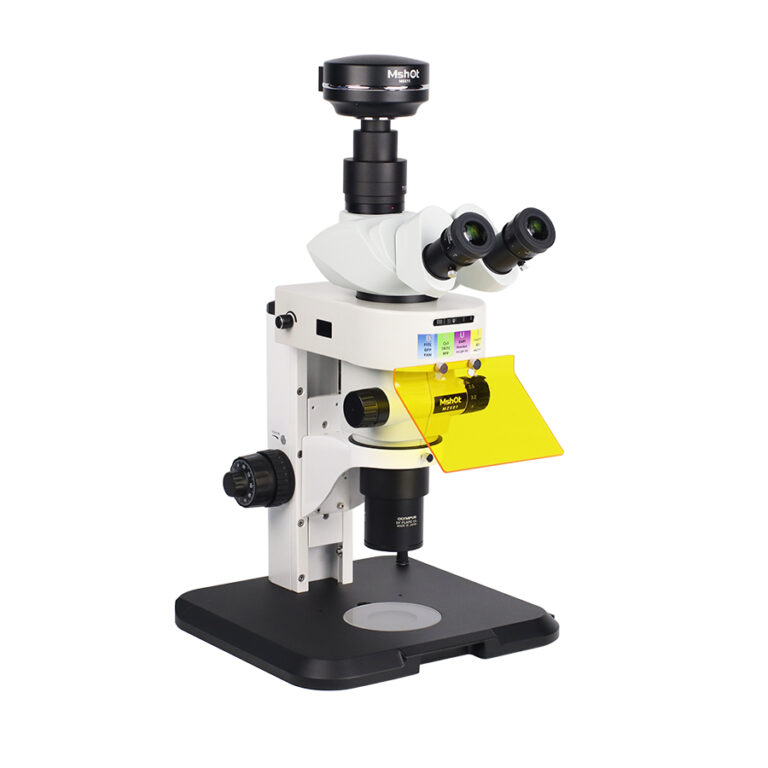
This can be achieved with either a fluorescence biological microscope or a fluorescence stereomicroscope, with fluorescence microscopes being more widely recognized. They feature flexible magnification, a large-stage design, and integrate brightfield and fluorescence analysis in one unit, simplifying workflows and improving both identification efficiency and accuracy.

Challenges of Microscopic Imaging in Writing-Seal Sequence Identification
When using a fluorescence stereomicroscope for writing-seal sequence identification, challenges include imaging clarity, color reproduction, light source adaptability, and high-power magnification.
It is necessary to ensure high-quality objective lens imaging, light sources that meet diverse requirements, and cameras with high resolution and high sensitivity to capture subtle features and color differences at the seal-writing intersection, thereby enabling accurate identification.
Solutions for Microscopic Imaging in Writing-Seal Sequence Identification
For writing-seal sequence identification, the MZX81-II is recommended. It complies with national standards for writing-seal sequence testing and integrates reflected, transmitted, and fluorescence observation functions. High-power objectives and LED fluorescence modules ensure accurate identification, while the large-stage design facilitates the placement of documents and materials.